
Photo by Dilara Mahmutyazicioglu
Understanding and implementing effective policies is crucial for their immediate well-being and the broader economic and human capital of both refugee and host communities. Immigrant integration, often described in terms of the ability of immigrants to lead successful lives within their host societies, involves accessing resources like economic opportunities, language skills, and social networks, crucial for navigating institutional landscapes and realizing potential. This dynamic, two-way process is influenced by both immigrants and the societal structures of the host country. This project explores the causal effects of policies on immigrant integration outcomes through natural experiments and detailed data analysis in the three Nordic countries Norway, Sweden and Denmark, employing registry data with harmonized survey data to study economic, social, and political aspects of integration. The combination of administrative data and surveys helps understand refugees’ sense of belonging and social identities, aspects not captured by registry data alone.
The project also delves into specific integration policies, such as language training and welfare benefits. Language training has been shown to improve employment outcomes and resident stability, particularly benefiting women and subsequent generations. Conversely, the effects of welfare payments on employment appear mixed, and there is no evidence yet of the effects on broader integration measures.
Furthermore, the project seeks to understand how policy-driven changes affect non-direct indicators of integration, like trust and gender equality attitudes. It challenges the assumption that economic and social integration are synonymous, pointing to the “integration paradox” where economically successful immigrants may feel socially and politically disengaged. Overall, the project highlights the complexity of integration processes and the need for nuanced, data-driven policy interventions to support immigrant populations effectively, with a particular focus on integrating vulnerable groups amid increasing global displacement.
With Andreas Kotsadam (Co-PI for Norway), Merlin Schaeffer (Co-PI for Denmark), Iman Abu Zueiter, Mathilda Gustafsson, and Karen Hauge.
Funded by: NordForsk (10 million NOK (~1,000,000 USD)).
Related Presentations:
Kao K. (2025). “Effects of Integration Policies on Long Run Outcomes in 3 Nordic Countries (Fugees)” was presented at the Nordic-Baltic Initiative for Migration and Integration Research (Nordforsk) Kick-off Workshop in Malmö, Sweden, June 17.
Project Components in Detail:
WP1: Collecting Survey Data and Linking it to Register Data:
This work package creates a powerful empirical foundation by integrating population-wide administrative register data with novel, in-depth survey data among refugees and hosts. Administrative data from Denmark, Norway, and Sweden allow for fine-grained, objective measurement of refugee outcomes, such as employment, education, language proficiency, emigration, and neighborhood context, combined with background variables such as refugee status and family links. This is augmented by detailed neighborhood-level indicators and geospatial data on ethno-religious infrastructure.
To overcome the limitations of registers for measuring subjective integration experiences, the project conducts large-scale surveys of 3,200 refugees per country, using validated instruments (e.g., IPL’s integration index) and novel experiments (e.g., trust games, vignette experiments). These surveys capture attitudes, values, gender norms, perceived discrimination, and political participation. By linking survey responses to registry data, WP1 enables causal analysis of integration mechanisms. Innovative sampling and response experiments will ensure representativeness, and host population data allow for two-sided integration analysis, examining how refugee presence and characteristics affect local residents and vice versa.
WP2: Neighborhood Effects
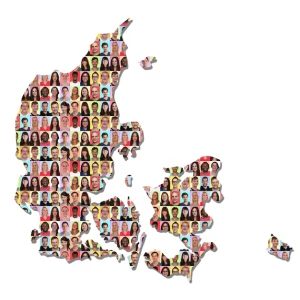
This WP investigates how the characteristics of the neighborhood refugees are placed in, such as co-ethnic density, diversity, socioeconomic status, and local labor market conditions; influence integration outcomes across economic, social, political, and psychological domains. Using natural experiments stemming from quasi-random refugee assignment, the project identifies the causal impact of neighborhood factors.
Building on prior work (e.g., Bratsberg et al. 2020), WP2 applies regression and machine learning approaches (e.g., causal forests, multilevel models) to assess both the total and heterogeneous effects of neighborhood context. The aim is to identify which neighborhood traits best facilitate or hinder refugee integration and how these effects vary across subgroups (e.g., by gender or origin). Both survey-based and registry-based outcomes are analyzed. This WP contributes key knowledge to debates on refugee dispersal policy, social cohesion, and local integration strategies.
WP3: Welfare Benefits
WP3 explores how the generosity of social assistance benefits affects not only labor market integration but also broader aspects of social and political integration. While reduced benefits may incentivize employment, they may also increase poverty, marginalization, and negative psychological or social consequences, particularly when cuts are perceived as targeting refugees.
The WP leverages large-scale natural experiments in Denmark, Norway, and Sweden. These include Denmark’s “Start Aid” reform (2002), Norway’s 2001 national benefit standard, and cross-municipal variation in Swedish social assistance evaluations. By combining register and survey data, the analysis isolates direct effects (e.g., on belonging, trust) and indirect effects (via employment or income). This approach goes beyond economic outcomes to test whether welfare policy promotes or undermines long-term integration, especially for vulnerable subgroups such as women. The results will offer evidence-based insights for designing welfare policies that balance efficiency with social inclusion.
WP4: Language Training and Introductory Programs
WP4 evaluates the impact of mandatory integration programs, which combine language training, civic education, and employment support. These programs are a central tool in Nordic integration policy, yet little is known about their broader social and psychological effects. While registry studies show some positive effects on labor market and language outcomes, the programs may also produce unintended paternalistic or disempowering experiences.
This WP capitalizes on staggered policy rollouts: Denmark’s 1999 Integration Act, Norway’s 2003 introductory program, and Sweden’s 2010 Establishment Act. By oversampling refugees arriving just before and after these reforms, the WP identifies causal effects of program participation. Survey data capture mechanisms such as self-efficacy, attitudes, and perceptions of paternalism, while register data track long-term integration outcomes. This WP addresses a key knowledge gap by evaluating whether introductory programs empower refugees across multiple dimensions or risk undermining inclusion by imposing narrow state-defined pathways.

This project breaks new ground by addressing major gaps in the integration literature with a highly ambitious, interdisciplinary approach that combines large-scale natural experiments, register data, and original surveys. By investigating the causal effects of initial placement, welfare policies, neighborhood context, and language training across economic, social, psychological, and political dimensions, it generates both empirical and theoretical advancements. The project uniquely identifies the scope conditions under which integration policies are most effective—across different countries, policy types, outcomes, and population subgroups. By also examining host population responses and two-way integration dynamics, it captures the full complexity of refugee integration.

